Files
Cover and headshot
Print-ready JPGs. Use them at any size. Please do not crop the cover or add filters to the headshot.
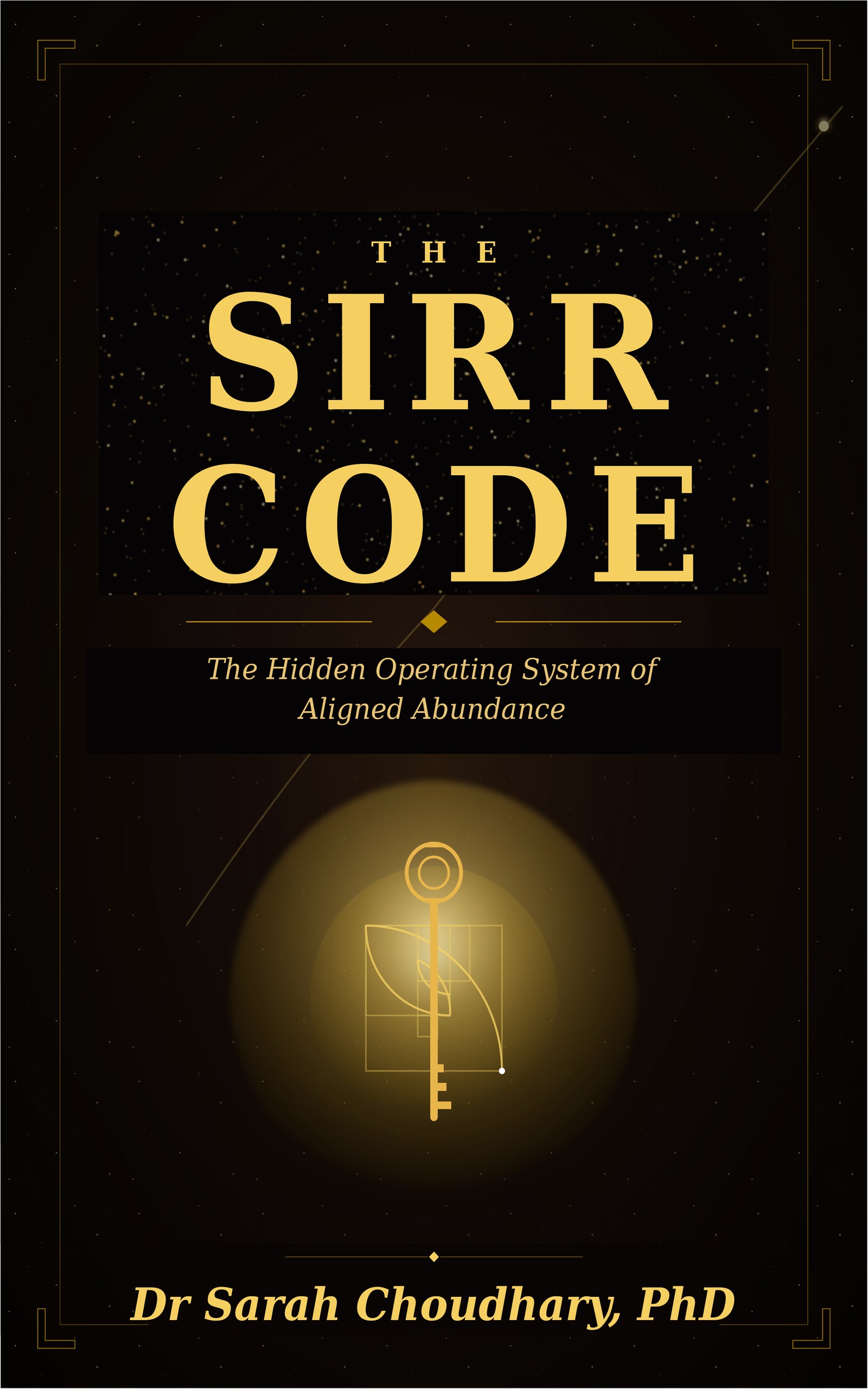
Front cover

Everything on this page is yours to use. Download the files, copy the bios, ask the questions.
Print-ready JPGs. Use them at any size. Please do not crop the cover or add filters to the headshot.
Reality does not deliver to the deserving.The central thesis
Reality delivers to the coherent.
Both are approved as written. Copy the one that fits your space.
Dr Sarah Choudhary is the founder and CEO of ICE Innovations and CTO of TrueAngles.ai. She advises executives and founders on AI and spent over two decades building enterprise systems. She holds a PhD in Data Science, serves on the Forbes Technology Council, and has seventeen peer-reviewed publications. She was raised inside the Sufi tradition.
Dr Sarah Choudhary is the founder and CEO of ICE Innovations and CTO of TrueAngles.ai. She advises executives and founders on AI. She spent over two decades building enterprise systems, as a consultant inside Big Four firms and as a senior data engineer at a major bank. She holds a PhD in Data Science, serves on the Forbes Technology Council, and has seventeen peer-reviewed publications. She spoke at Inside Quantum Technology's Quantum+AI conference in New York in 2024 and 2025 and was an AIconics Awards finalist for AI Implementer of the Year. She was raised inside the Sufi tradition. Her book, The Sirr Code: The Hidden Operating System of Aligned Abundance, maps a six-node circuit (Identity, Energy, Attention, Creation, Momentum, Magnetism) that explains why high performers plateau after they win and how aligned abundance compounds. Reality does not deliver to the deserving. Reality delivers to the coherent. She is also the girl in Chapter One.
Name style: Dr Sarah Choudhary on first reference, Dr Choudhary after that.
Each one leads to a part of the argument. Ask them in any order.
The book runs on a six-node circuit: Identity, Energy, Attention, Creation, Momentum, Magnetism. Why does the order matter, and what happens when someone skips a node?
Your readers are people who won. The title, the exit, the number on the spreadsheet. Why do high performers plateau after the win, and why does pushing harder make it worse?
You ask readers to run the circuit for ninety days, in three thirty-day gates: an identity audit, an operational rebuild, then evidence accumulation. What should someone notice at day thirty, at day sixty, and at day ninety?
Chapter One is a childhood: a quiet apartment, a lock on the refrigerator, a mother met in secret at the school gate. A seven-year-old makes a decision in the corner of a quiet room. What does that decision have to do with wealth?
You were raised inside the Sufi tradition and you write as a data scientist. In the book you call the Sufi teaching an inheritance, not a proof. What does a reader with no faith do with it?
Recent conversations with Dr Choudhary. Each name links to the episode.
Interview requests, press questions, and speaking inquiries go to one address.
sarah@sarahchoudhary.com